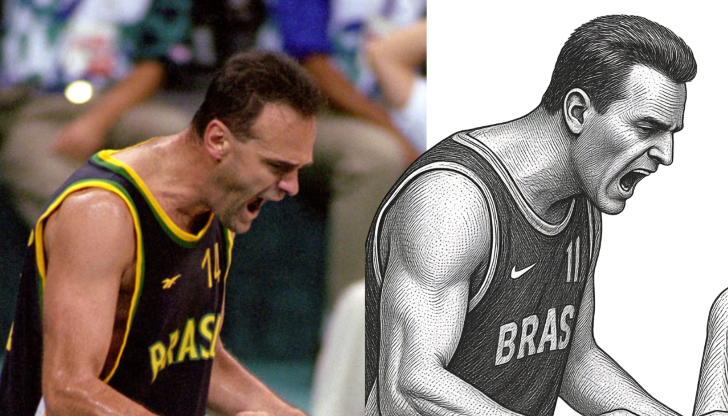
There is a certain kind of greatness that needs no championship ring to validate it. Oscar Schmidt never won an Olympic gold medal for Brazil. He never played a single minute in the NBA. And yet, when the Basketball Hall of Fame inducted him alongside its finest, nobody seriously questioned whether he belonged. For nearly three decades, Schmidt did something almost no athlete in any sport has managed: he became definitively, statistically, the most prolific scorer in the history of his game. On April 17, 2026, the man his country called Mão Santa — the Holy Hand — passed away at 68, after a long battle with a brain tumour. Basketball lost one of its genuine originals.
Oscar Schmidt Biography
| Detail | Information |
|---|---|
| Full Name | Oscar Daniel Bezerra Schmidt |
| Nickname | Mão Santa (Holy Hand) |
| Born | February 16, 1958, Natal, Rio Grande do Norte, Brazil |
| Died | April 17, 2026, Santana de Parnaíba, Brazil |
| Age at Death | 68 |
| Nationality | Brazilian |
| Position | Small Forward / Power Forward |
| Height | 2.06 m (6 ft 9 in) |
| Career Span | 1974 – 2003 (29 years) |
| Career Points | 49,973 (club + national team combined) |
| Olympic Points | 1,093 — all-time record |
| Hall of Fame | FIBA Hall of Fame (2010); Naismith Basketball Hall of Fame (2013) |
| Cause of Death | Brain tumour (following prolonged illness) |
Early Life and Background
Oscar Schmidt was born in Natal, a coastal city in the northeastern state of Rio Grande do Norte — not a place typically associated with basketball in Brazil, where football dominates the cultural landscape so thoroughly that other sports often struggle to gain a foothold. That Schmidt emerged from this environment to become the greatest scorer in the sport’s history is, in itself, a story worth examining.
He debuted for the Brazilian national team at 19 in 1977, which tells you something about how quickly his talent was apparent to people who watched him play. By his teenage years, he was already developing the technical habits — a precise, almost surgical shooting touch, combined with a strong physical frame — that would define his career. He played in the youth systems of S.E. Palmeiras and Mackenzie College, scoring at extraordinary rates even at junior level.
What made his development unusual was not just raw talent but a commitment to a style of play that was, in the early 1980s, considered somewhat unorthodox. He was a keen three-point shooter at a time when many coaches actively advised against it — and that shooting instinct earned him the nickname “Mão Santa,” or Holy Hand. In hindsight, he was ahead of the game by at least a decade.
Career Journey
The Brazilian Foundations
Schmidt began his professional club career in 1974, at the age of 16, with S.E. Palmeiras. He was a teenager taking on grown men, and he more than held his own. After winning titles with Palmeiras and later E.C. Sírio, his reputation had grown to the point where European clubs came calling — a significant development in an era when Brazilian basketball was not yet a globally recognised product.
The European Chapter
Between 1982 and 1990, Schmidt played in Italy for JuveCaserta Basket, where he became a childhood idol of a young Kobe Bryant. That detail is not mere trivia — it says something about the quality of his play and the impression he left on those who watched him. He later played in Spain for Fórum Valladolid before returning to Brazil in the mid-1990s.
The NBA Decision That Defined His Legacy
In 1984, the New Jersey Nets selected Schmidt in the sixth round of the NBA Draft. Most players would have jumped at the chance. He turned it down. At the time, NBA players were not permitted to play for national teams, and Schmidt would not sacrifice his place in the Brazilian squad for any contract. That choice — principle over personal gain — became central to how Brazilians understood and celebrated him.
The Olympic Years
Schmidt competed at five consecutive Olympic Games: Moscow 1980, Los Angeles 1984, Seoul 1988, Barcelona 1992, and Atlanta 1996 — a span of sixteen years during which he was consistently Brazil’s most important player. He tallied 1,093 points across 38 Olympic matches, never scoring fewer than 14 points in any single game. His best single-game performance was 55 points against Spain at Seoul 1988 — a record that still stands.
There were performances that transcended box scores entirely — among them, an unforgettable 1987 Pan American Games final in which Brazil dismantled Team USA, with Schmidt scoring 46 points, and a clutch sequence in the 1996 Atlanta Games where he secured victory over Puerto Rico with three free throws and a basket in the final moments.
The Record Books
Schmidt held the distinction of being considered basketball’s all-time leading scorer with 49,973 career points across professional club play and national team appearances — a figure that surpassed Kareem Abdul-Jabbar’s mark — until LeBron James broke the record on April 2, 2024. He also holds the record for the longest career span of a professional basketball player at 29 years, retiring from club basketball in 2003 at the age of 45.
The Brazil Basketball Confederation, in its tribute, described him as “the holder of a trajectory that redefined the boundaries of what was possible on a court.”
Influence and Legacy
Schmidt’s influence on basketball in Brazil and across South America is difficult to overstate. Luis Scola, who became one of the greatest South American players of his generation, named Schmidt as his favourite player growing up, recalling how he had once mopped the court just to be near him during a tournament in Argentina. The ripple effect of a player like Schmidt — technically brilliant, nationally devoted, principled enough to turn down the NBA — runs through an entire generation of South American basketball.
Some contemporaries, including coaches who faced him, said loudly that Schmidt was “as big as Michael Jordan” — a comparison that will raise eyebrows in some quarters but reflects the absolute dominance he wielded in international basketball outside the NBA’s orbit.
He was inducted into the FIBA Hall of Fame in 2010 and the Naismith Memorial Basketball Hall of Fame in 2013 — despite never having played a single game in the NBA. That second induction, in particular, is a statement about how basketball’s global governing minds eventually came to understand greatness: not defined by one league, one country, or one set of circumstances, but by what a player actually did on the floor over a lifetime of competition.
The Brain Tumour and His Final Years
In 2013, at the age of 55, Schmidt announced he was being treated for a brain tumour — news that stunned the Brazilian sports community. Characteristically, he faced it publicly, speaking openly about his condition and maintaining his positive image throughout. He recovered and even appeared at public events in 2016 to speak at a forum on cancer treatment. But the illness eventually returned.
He was hospitalised after falling ill in his final weeks, and passed away on April 17, 2026, in Santana de Parnaíba, Brazil. The official cause of death was the brain tumour he had been battling for years. He was 68.
Personal Life
Schmidt was a family man who kept his personal life relatively separate from his public profile. His son Felipe played basketball alongside him but ultimately chose a different path, pursuing a career as a music video director. That detail carries a kind of warmth — a father who introduced his child to the sport he loved, without demanding that the child follow him into it.
He remained a friendly and accessible figure in Brazilian media throughout his life, known for a warmth that sat comfortably alongside the fierce competitive instinct that made him a scoring machine on the court.
Conclusion
Oscar Schmidt played basketball for 29 years, scored nearly 50,000 points, competed in five Olympics, and turned down the NBA to stay loyal to his country. He faced a brain tumour in public with the same calm clarity he brought to everything else. What makes his story genuinely remarkable is not any single statistic — it is the consistency of who he was: a player who defined himself entirely on his own terms, in an era when the NBA represented the obvious summit and he simply chose a different mountain. Brazil has produced extraordinary athletes across many sports. In basketball, there has only ever been one Holy Hand.
Frequently Asked Questions
What was Oscar Schmidt’s cause of death? Oscar Schmidt passed away on April 17, 2026, after a prolonged battle with a brain tumour. He had first announced his diagnosis in 2013, recovered, but the illness returned in his later years. He was 68.
Did Oscar Schmidt ever play in the NBA? No. The New Jersey Nets selected him in the 1984 NBA Draft, and he trained with the team, but he declined to sign a contract because NBA rules at the time prevented players from representing national teams.He chose Brazil over the NBA.
How many points did Oscar Schmidt score in his career? He accumulated approximately 49,973 career points across professional club play and appearances for the Brazilian national team — a figure that made him basketball’s all-time leading scorer until LeBron James surpassed the record in 2024.
How many Olympics did Oscar Schmidt compete in? He appeared at five Olympic Games — Moscow 1980, Los Angeles 1984, Seoul 1988, Barcelona 1992, and Atlanta 1996 — scoring 1,093 points in total, the all-time Olympic record.
Why was Oscar Schmidt called “Mão Santa”? The nickname, which translates as “Holy Hand,” came from his exceptional shooting accuracy — particularly his early and extensive use of the three-point shot at a time when most coaches considered it a risky strategy. His precision from distance set him apart and became his signature.